The Waiting Room - Part I
“I need your help to die,” is far from a comforting introduction from a stranger, especially when that stranger arrives in a hospital waiting room in Taiwan, a place you’ve returned to in order to seek more affordable medical treatment than the $53,400 in out-of-pocket expenses incurred while seeking diagnosis and treatment for the black holes that have mysteriously appeared inside your body.
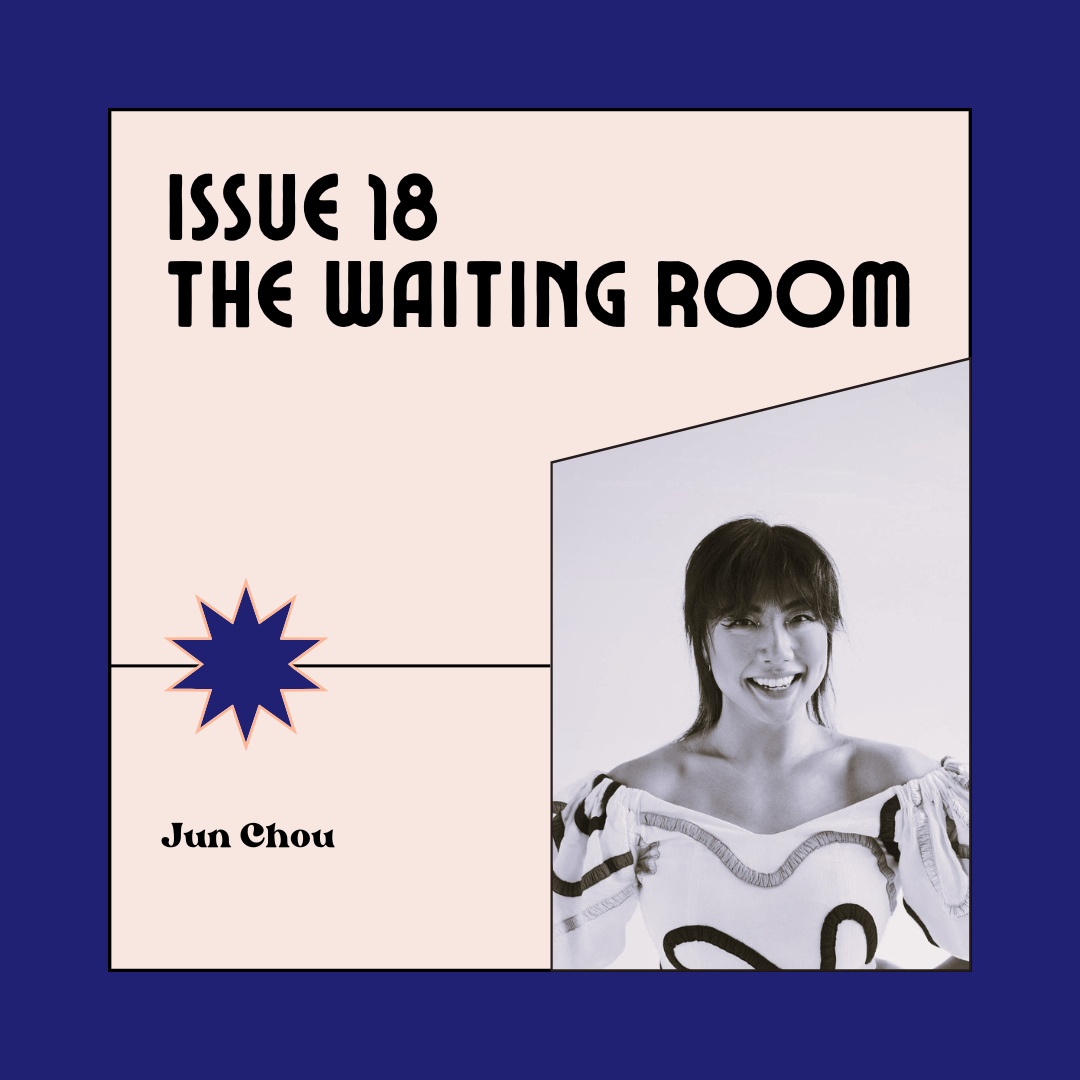
For the narrator of Jun Chou’s lyrical and surreal, “The Waiting Room,” this enigmatic meeting catalyzes a moving journey through landscapes both real and remembered in Taiwan and Brooklyn. Tender and incisive, “The Waiting Room” centers aging women in its meditation on modern medicine, kinship, and what it means to be a parent.
-Michael
Six rows of 10 pastel pink chairs face a set of swinging doors with matching windows like submarine portholes, as if we are audience members, clenching until the doctor bustles on stage from behind the curtain, selects us as Lucky Contestant Number whatever.
Of the 59 empty seats, some old lady chooses to sit directly next to me. Her frenzied entrance into the waiting room snaps me out of my haze. The chain on her fake Fendi makes a loud clank as it slams the seat in front of her. Her head is low, a crimson perm with hair so sparse I can count the liver spots on her scalp. I try not to stare as she performs an exorcism on her nose with a crumpled napkin from her left pocket.
She billows a swift Taiwanese in my direction. I glance sideways, trying to decipher if her mutters are directed into an earpiece or if a relative has appeared beside her but no—it’s just us in the waiting room.
“Are you talking to me?” I point to my chest and address her in my choppy Mandarin. She nods fervently and grabs my arm with the overfamiliarity of the elderly in Taiwan; in a culture where seniors are venerated, anyone older becomes your default grandma or grandpa. “I’m sorry, I don’t speak Taiwanese,” I say. She switches to Mandarin: “I need your help.” Her urgent tone advertises the familiar solitude of the lonely variety.
“I need your help to die.”
By the time her words register, a nurse with high cheekbones and a hairy chin pimple calls out my Chinese name. I don my kindest eyes for the grandma and pat her hand before plucking her death grip off my forearm. Her skin is shockingly smooth, the folds of her wrinkles imperceptible to my touch. “That’s me,” I say. “Can I come find you after?” Her eyes cloud over with impending storm. The lightning of her gaze pierces my back as I walk towards the examination room.
*****
My newest scans are already up—backlit and electric blue on black. A wave of simultaneous relief and disappointment crushes me when I see today’s scans: the black holes have moved. Again.
The doctor, a baby-faced man with a growing-in fade no older than 30, launches straight into his assessment.
“This,” he starts, tapping a silver rod against the largest black hole and addressing it directly. “I have never seen anything like this.”
I hold my breath as a weight settles in my stomach, as though the mysterious spot near my heart has become a giant stone sinking quickly towards my belly.
“You should be dead!” He laughs and shakes his head. “I honestly have no idea how you’re still breathing.” It takes digging my fingernail into my palm to prevent a snort at his frankness.
“That’s what the doctors in America said.” I sigh. “I was hoping the medical superiority of Asia would yield different results.” My swift Mandarin surprises me, as well as my passive aggression; I wasn’t aware of the translations for superiority or yield until they spilled from my mouth.
The young doctor is nonplussed. In fact, he seems to have forgotten my presence entirely. He’s fogging up my scan with his up-close breath, examining my lungs while shaking his head and muttering just like the grandma in the waiting room. “Impossible,” he continues to himself, in English this time. “This is impossible.” He yanks today’s sheet from the illuminator and whips around to face me.
“We will have to run more tests,” he says as he meets my eyes for the first time. Immediately, he blushes and turns away, seemingly more comfortable addressing my agender skeleton than my plump, feminine frame. I have gained over 10 pounds throughout my month in Taiwan—my grief, illness, and nostalgia serving as convenient excuses for my overconsumption of the country’s inexpensive, accessible, delicious, fried foods. My first scan, taken two months ago in a claustrophobic hospital in West Harlem, looks the same as the one today, if not for the locomoting black holes around my chest and abdomen. The scans in sequential order tell the visual tale of my widening body mass from the past few weeks. I chide myself for the thought: Who cares that you’re fat if you’re dying?
The black hole was daisy-shaped the first time I saw it. I had been experiencing persistent abdominal pain, and my primary care physician told me we should take a full-body CT scan to be safe. The scans revealed a gaping void where my uterus should be. The doctor scanned himself and two nurses next. When he confirmed it wasn’t a machine error, he sent me to the Cardiology wing at Mt. Sinai. By the time I was able to get an appointment a week later, the hole wasn’t in my uterus anymore. The doctors ping-ponged me around the hospital, running all the rudimentary tests: X-rays, MRIs, biopsies, colonoscopies, ultrasounds, electrocardiograms. I had never been stabbed by so many phlebotomists in my life. The out-of-pocket total was close to $53,400 (my measly insurance helped cover $173,400, after I hit my deductible) for all the blood tests, imagings, specialist consultations, diagnostics. This carved out the bulk of my savings and resulted in zero conclusions. I answered the same questions from dozens of different doctors. None of them talked to each other.
“I have to consult with my colleagues,” the Taiwanese doctor says, all but shooing me out of sight.
“Hao,” I say: Fine, in Chinese. I pray my petulance translates. Though my parents have long passed, returning to my birth country always slams me back to the chaperoned summer vacation visits of my childhood. My 45th birthday is next week. No one even knows I’m here.
Back in the waiting room, I scan for the grandma’s crimson head. I don’t see her anywhere, so she must be getting examined. I sit and wait. I’ve nothing better to do, anyway.
The waiting room is on the 9th floor of the hospital, conveniently 15 strides away from the radiology wing. Technically, I guess, we are on the 8th floor; it isn’t 13 that denotes bad fortune in Taiwan but 4, the singular Chinese syllable synonymous with death. The winter sun blinks her bleary eyes through the high-paneled windows. I watch as the receptionist catches her dozing head from falling off her right hand while swiping TikToks with her left. Snippets of scrambled Mandarin, staccatoed with high-octane American pop songs—always the same three second-clips—echo into the waiting room.
I open Instagram mindlessly on my phone, and a selfie from Patrick’s account with his new girlfriend makes me immediately swipe the app shut. I attempt a meditation on the present moment. A child in a tutu and fuzzy headband with cat ears runs around twirling a limp fairy wand.
“You’re healthy!” she deems a liver-spotted grandpa hunched over in the pink waiting room chair.
“You’re healthy!” she blesses a boy wearing a striped rugby shirt and an eyepatch.
“You’re healthy!” she announces to a moody teenager in an arm sling.
“You’re healthy!” She taps her wand on my chest—exactly where my scans show I have been scooped out today. She shrinks when she sees my scowl. The mother receives her child on her lap and brushes flyaways behind her ear. The little girl whispers a secret and her mother glances in my direction before focusing her attention on comforting her child. Have I become the scary spinster that children tell tall tales about? Alone in her haunted castle, the loner with rumors swirling about witchcraft and strange critters? I suppose the assessment is not far off, except that I’m all alone after Bucky’s recent death. Plus, ever since I plucked my first white hair from my hairline two months ago, I’ve exterminated at least a dozen more.
Back in Brooklyn, I lived alone in a studio apartment filled not with cauldrons but Chinese takeout containers. I try to imagine my apartment now—the setting for an entire decade of my life—but cannot even conjure the tiles of my backsplash.
The grandma struts out from the swinging doors, shoulder to shoulder with a nurse in soft yellow scrubs, a matching surgical mask, and icy blue contacts transforming her irises. The nurse matches the grandma’s slow pace and pats her on the shoulder as though transmuting condolence. I stand up straight-backed, surprising myself with this sudden clutch of loyalty toward this stranger. The nurse hands her off to me, no doubt assuming me her daughter. Neither of us corrects her mistake. The grandma links her arm through mine, holding me with the same talon grip as before.
*****
We make it three blocks before she asks to stop. It’s hot and she’s sweating through her bedazzled sweater, which is made from an unbreathable cashmere. The calendar technically denotes winter but Taiwan’s tropical climate eschews any seasonal logic. There’s a 7-Eleven on the corner so we amble there to catch our breaths from the humid afternoon sun. I order for us as she rests on the high-top stool, fanning herself with a local politician’s flyer that was shoved at us outside the hospital. The pearls in my brown sugar bubble tea are too mushy but I suck entire slats of ice through the wide straw to cool down.
In Taiwan, 7-Elevens are mightier than any convenience store in America, even superior to my favorite bodega in Brooklyn; they’re bountiful, resplendent, wonderful institutions—the backbone of the country. You can buy pet food and makeup and bento boxes or have a beer or pay your taxes or call a taxi—all under the same bright fluorescence. Whenever I get bored, I go to the closest 7-Eleven just to browse the short aisles: ramen with real dehydrated beef, fuzzy barrettes, caramel pudding with individually packaged spoons, rows of passion fruit green tea, glossy magazines with Korean pop stars. There can be up to three 7-Elevens on a single block, and none of them will be empty. The blast of air conditioning and bright lights bring me calm after the inconclusive frustration of my hospital visit. Apart from the city officials who helped me with my healthcare registration, this grandma is the first company I’ve had during my time in Taiwan.
We were silent the entire walk over, but she picks up the conversation right where we left it hours ago in the waiting room.
“I need your help to die,” she repeats.
I choke on the unchewed pearls in my mouth. She delivers her request at such an even interval, the same tone used when making an appointment or notifying someone the toilet paper is out, that it does not sink in again until I hear the cash register beep behind us. Her expression contradicts the intensity of her statement. There is peace in her pupils. A calm sky after the storm. I do not see the darting eyes of someone unstable and erratic, the familiar eyes of my mother.
“Wei she me?” I ask in Mandarin. Why?
“I’m already dying,” she says, blowing to cool her coffee. “My children have grown up and left. I’m all alone. I don’t want to go through another painful treatment just to come back to the same life I have now. I’m tired.”
I nod, understanding, because I do.
Back in America, my life had been swirling down the toilet in a cyclone of work, gym, and home. I have no children, not from a lack of desire but lack of opportunity. I was not depressed about this fact until I underwent early menopause last year while simultaneously gripped by a maddening baby fever. Why now? I cursed my uterus. Now it’s too late. I looked into adoption, perhaps skipping the turmoil of infancy and getting an elementary-school kid, but the process was too long and expensive for a single mother. So, I went to the local shelter and came home with a cross-eyed pitbull instead. If it weren’t for Bucky, I don’t know if I would still be alive.
“Don’t you have children?” I ask the grandma.
She waves me off. “My daughter and son are both grown, with their own families to worry about. They don’t need me anymore. They never really did.”
I notice how steady her hands are when I feel mine trembling. She reaches over and pats my cheek tenderly. Once again her skin’s softness shocks me. “I’ve lived a good, long life. Haven’t eaten that much bitterness. Believe me: I am dying happy.”
I swallow stale saliva, say nothing. Then I tell her I’ll think about it.
Jun Chou is a solar-powered human, Brooklyn-based writer, and Asian American Writers’ Workshop 2025 Margins Fellow. Her writing has previously appeared in Electric Literature, Cake Zine, Hobart, and is upcoming in Honey Literary. She also interviews creatives of all disciplines as a regular contributor to The Creative Independent. During the day, she improves recipe discovery for The New York Times Cooking. Other times you can find her belting karaoke, adding to her Letterboxd, rock climbing, or drafting her debut novel.