5 Questions with Jun Chou
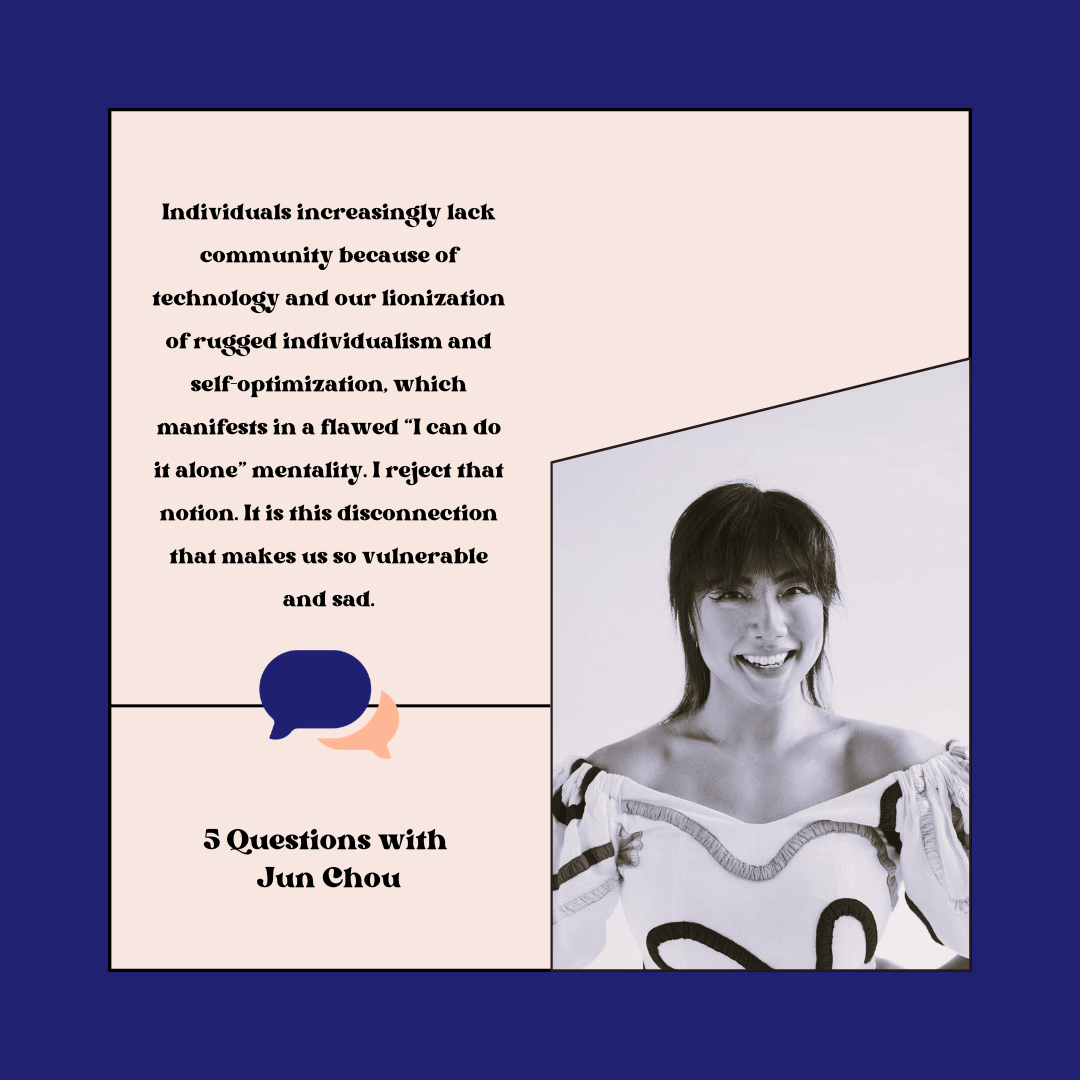
After publishing the final installment of Jun Chou’s story, “The Waiting Room,” Michael Colbert caught up with Jun about the dystopia of American healthcare, Harold and Maude, and how we narrativize our lives.
These two narrators find so much kinship in their unique loneliness. How were you able to get so deep inside of these characters?
I never know who my characters are when I start a story; I like to let them surprise me. In this story for example, I had no idea the Grandma was going to be such a gangster until she unfurled on the page. The main character emerged from what I’m realizing now are my existential fears about aging, loss, and loneliness. One of my favorite films growing up was Harold and Maude, a dark comedy about a young boy (Harold) and a geriatric woman (Maude) who have a meet cute at a stranger’s funeral: he’s there because of his morbid fixation on death (he drives a hearse and stages fake suicides to the dismay of his detached mother), while Maude is in attendance due to her joyful philosophy of memento mori. Their friendship sparks a delightful tale about joy in an absurd world and includes one of my favorite diegetic movie moments featuring Cat Stevens’ “If You Want to Sing Out, Sing Out.” As “The Waiting Room” progressed, I knew I wanted to emulate Harold and Maude’s chemistry with the two main characters.
I find myself drawn to lonely characters who alienate themselves and hide behind emotional walls as a method of self-protection. What that says about me I save for my therapist. I ruminate often on the blurry line between loneliness vs. solitude, which thus emerges (subconsciously or not) as a theme in my writing. Perhaps my fixation is the result of my juvenile obsession with that Jack’s Mannequin song “Dark Blue”that goes: “Have you ever been alone in a crowded room?” Loneliness, borne not solely from solitude, but from being misunderstood or unseen.
Individuals increasingly lack community because of technology and our lionization of rugged individualism and self-optimization, which manifests in a flawed “I can do it alone” mentality. I reject that notion. It is this disconnection that makes us so vulnerable and sad. As social creatures, humans are wired to crave connection and belonging. Healing cannot happen in a vacuum. Romantic connection can be the salve but it’s not the only one; the best relationships in my life are the platonic ones.
I'd love to talk about memory. The narrator has such a fine-tuned relationship to home in New York and their dog Bucky. I found the way you can unravel an entire history in a paragraph to be quite stunning. How were you able to control the amount of flashback so effectively?
Wow, thank you so much! I feel like I struggle with moving between the past and the present in my writing and moderating exactly how much is too much, so I appreciate your note.
I’m so curious about how the ways in which we narrativize our lives distort or shape our memories. Phases, relationships, entire childhoods that collapse down to single paragraphs.
I’ve lived in New York for seven years now and if I ever move away, I wonder what I’ll remember. There are so many moments that make up a day and it feels simultaneously like I’ve lived here forever and no time at all. I also spent a year living in Paris, which felt so transformative and fruitful, but that time has since been reduced to one or two vignettes. I’m certain there are so many small moments and delights I’ve forgotten throughout the years because that’s just how memory works (granted, I have a notoriously porous brain). But I’m obsessed with how unexpected things, like a smell or a sound, trigger the most random flashbacks. Just the other day I was listening to “Cheap Sunglasses” by RAC and I was immediately That’s So Raven’d by a memory of driving, windows down, to the beach with my best friend. These flashbacks occur all the time in our lives and I wanted to capture that feeling on the page.
I love getting That’s So Raven’d.
This story is also a medical drama, and I was captivated by the way the story's magic brought to life the unreality of medical care in our world. Where did that part of the story begin for you?
I began this story in Taiwan while nursing a broken heart. During my early morning walks in beautiful parks or long waits in examination rooms, I thought constantly about how memory distorts in the fugue state of grief. It didn’t occur to me at the time, but those quiet days invoked in me a story of transforming a sterile hospital into abundant vitality.
Whenever I return to the country where I was born, I leverage my citizenship to access its universal healthcare. It’s such a stark difference from America, where you wait weeks for an appointment, never get an accurate quote on a procedure, and institutions operate in frustrating silos.
There was one time I received a confusing bill from a lab. The time, effort, and energy it required to call my doctor’s office, my insurance company, the laboratory, was staggering. I had spreadsheets of call records and notes from all the conversations I had because nobody talked to one another. The case probably dragged on for a year before the lab dismissed the charge and by that point, the bill had made its way into collections, which was a whole other headache.
You’re expected to do your own research instead of trusting the doctors and there’s a dystopian sense that one medical emergency can bankrupt you. Everyone agrees the American healthcare system is broken but nobody knows how to fix it. Something I touch on in the story is the sad reality of sick people and their families raising money through platforms like GoFundMe. Yes, it can be uplifting to see people providing financial care to strangers but it also exposes the sordid reality of our healthcare system.
Without any spoilers, I was really compelled by how much you reveal about the grandma's status at the ending. What's your relationship to surrealism in fiction?
One of my biggest inspirations is Ling Ma, who is a master at smudging surrealism into her fiction to expose the absurdities of real life. My favourite short story of hers is about two friends who take a drug that makes you invisible. Although it’s such a fascinating premise, the story is not really about the drug but what it reveals about their desires. What does a drug that makes you invisible mean to someone who wants to disappear?
I gravitate towards art in that vein. I just finished watching the second season of Beef, which expertly explores rage and long-term relationships. While it takes place in our world, the way show creator Lee Sung Jin incorporates surreal elements to expose universal existential fears is amazing. It’s something I try to emulate in my own writing. Much like what I was just talking about in regards to healthcare—many things we accept as normal in our lives are really quite strange once you dissect them into abstraction and absurdity.
What's exciting to you in fiction right now?
Even though I’ve been a fan of his ethos and essays for years, I’m embarrassed to say I only recently read my first James Baldwin novel. Another Country blew me away. Not only his ability to construct lyrical prose like the teenage preacher he was, but also his meticulous handle of the human psyche, beautiful descriptions of 1950’s New York, and ineffable capture of captivating conversations. Whenever I read writing from another decade, I’m struck by how timeless themes of yearning and isolation are. On my 2026 bingo board is a square to read three more novels by Baldwin so Giovanni’s Room is next in the queue.
I also love reading short stories during my commutes. Some good ones that have haunted me recently are Stick Season by Jenny Xie and Ghost Lover by Lisa Taddeo.