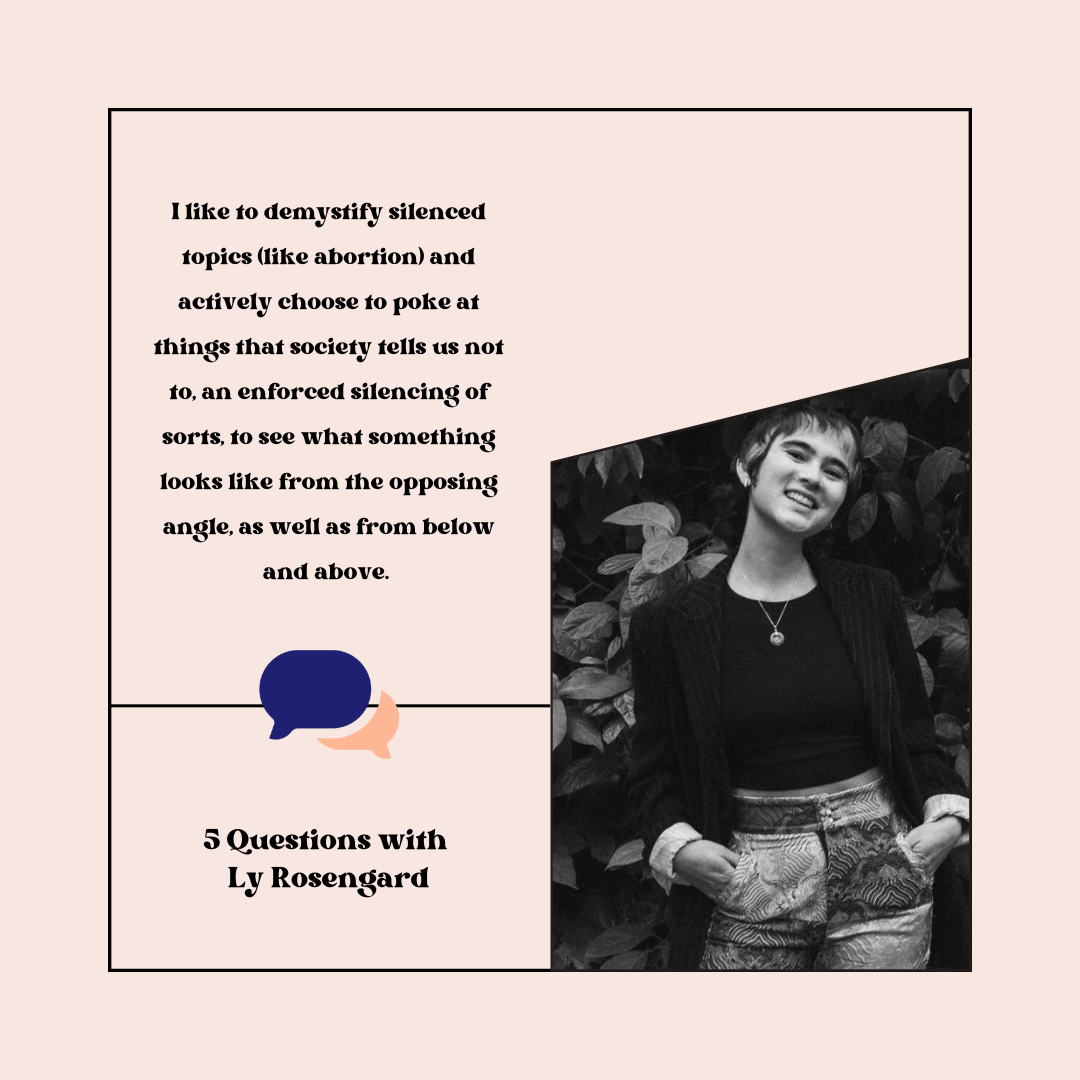
5 Questions with Ly Rosengard
Last week, we published the final installment of Ly Rosengard’s story, “Abort Mission.” Emily Lowe spoke with Ly about voice, queer community, and the overlaps of advocacy and art.
I fell in love with the concept of your story right away. A lesbian pregnancy is so provocative and, to me, reaches to fill a hole in the queer canon. What queer literature most inspires you and how is your story in conversation with it?
That’s so kind. Thank you so much! When I write or create anything, I want to highlight diverse, marginalized, or typically taboo stories that are not frequently told, primarily to shine light on certain topics and end stigma so that people feel less alone. In life, there is the conventional route, the track that society tells you to be on. For example, be straight, be monogamous, get engaged (during a hike, preferably while hiking with your dog), get married then procreate. If you don’t follow that path, then it seems that anything outside of that is uncharted territory, where we’re all left to our own devices to figure it out/spiral. I hope that telling a story of an unexpected lesbian pregnancy and an adjacent trans masc pregnancy that both end in termination, normalizes these topics in terms of gender and sexual diversity and the fundamental right of bodily autonomy of each and every pregnant person over their own body. My goal is that upon reading this story, readers think differently and more expansively about the topic.
There is so much incredible queer literature that inspires me, including fiction writers and books like Torrey Peters’ Detransition Baby and Stag Dance, Carmen Maria Machado’s In The Dreamhouse and Her Body and Other Parties, Ocean Vuong in On Earth We’re Briefly Gorgeous, Zaina Arafat in You Exist Too Much, and Bernadine Evaristo in Girl, Women, Other, Saba Sams in Send Nudes. I’m also a lover of non-fiction, for example Audre Lorde’s Sister Outsider and The Cancer Journals, Roxane Gay’s Bad Feminist and Hunger, Paul B. Preciado’s Dysphoria Mundi, Ruby Rare’s Sex-Ed for Adults, Liara Roux’s Whore of New York, Brigitte Vasallo’s Monogamous Mind, Polyamorous Terror. My writing aspires to be in conversation with these phenomenal books that changed my life for the better, and helped me understand realities both similar and different from my own.
These authors do not merely insert queer characters and call it a day but inhabit the world of queerness and then flipped the script on what you would expect from a rainbow love is love type slogan, which is truly a reduction, a sanitized whitewashed version of being the ‘type of queer’ that is acceptable in a white supremacist, heteronormative, patriarchal and capitalist society, or as Preciado defines it, a petrosexoracial regime which is ‘the expansion of colonial capitalism and the extension of racial and sexual epistemologies from Europe to the entire planet […] extraction, combustion, penetration, appropriation, possession, destruction.’ These authors show the messiness, the complexity, and the juiciness of what it truly means and looks like to be part of the LGBTQIA+ mafia. I will forever refuse to box in my characters (or myself), into what being queer or trans should look like from the outside compulsory heteronormative (comphet) world inwards, but instead lead from the other way around, driving the narrative—as bell hooks so aptly put it, moving our stories ‘from margin to centre’.
Planned Parenthood has a large role in this story both thematically and structurally. These scenes are both essential and inherently political. How did you navigate this subject? And how does the political pair with the literary for you?
As an activist and advocate, the personal is always political. This includes through my writing, which is why this story intentionally brings together topics typically estranged: Queerness. Transness. Pregnancy. Abortion. Humor. Friendship. Bodily Autonomy. Polyamory. Kourtney Kardashian. It is an unlikely pregnancy story that centers a budding friendship between a non-binary lesbian and a tboy outside a Planned Parenthood, and entirely decenters cis men (which I consider a win).
I am not a person who feels confined to any particular medium, but instead I attempt to choose the right media to fit each idea. For example, earlier this year I decided that given the current global context of rising fascism around the world, the on the ground experience of queer and trans spaces as sites of joy and resistance must be documented and archived as an integral part of our histories, hence why for this, I decided the best way forward was to direct and film a documentary focusing on QTBIPOC kink and erotic space here in NYC, with an added cross-cultural exchange with queer trans friends across the ocean in Nairobi because we must document our histories around the world. When we document our histories, we can never be erased.
My main goals in my life is creativity and humor 1) for the community itself: to ensure people feel less alone, and 2) to those outside the community: to make important topics accessible and interesting to people who may not otherwise extend empathy to issues they do not understand. In this way, I seek to humanize misunderstood or underrepresented topics, whether it is about bodily autonomy, sex work, polyamory, queerness, transness, and so on, to take back the narrative, showing that our lives cannot simply be politicized and are not just those of headlines and policy debate, but are full, loving, and joyous.
I like to demystify silenced topics (like abortion) and actively choose to poke at things that society tells us not to, an enforced silencing of sorts, to see what something looks like from the opposing angle, as well as from below and above. This fictional story, “Abort Mission,” is inspired by my own lived experience, for we write best what we know, and it occurred shortly after my move to the U.S., just a couple weeks before Roe v. Wade was overturned, so that is the devastating political moment which looms large over this story, like a ghoul about to present itself soon thereafter. Of course, at the time, your average person had no idea that this was about to occur. So to write this retrospectively also brings that gravitas to it beyond the piece itself.
‘My body, my choice’ and the sentiment that it upholds—that of bodily autonomy—is the mainstay of feminist activism the world over, from the Women, Life, Freedom movement in Iran, to ending gender apartheid in Afghanistan, to large-scale protests against femicide in Kenya, to mass mobilization to end gender-based violence in Mexico, to the ongoing fight for sexual and reproductive rights in the U.S. The struggle for freedom over our bodies is a core tenet of gender equality. Feminists have fought for decades over restrictions over our bodies thrust upon us by cis men in power who seek to control us. Whether it is about prohibiting abortion services, to banning gender affirming care, to defunding sexual health clinics, it is clear that our bodily autonomy and integrity and our right to choose what happens to our bodies threatens the mainstream power structure.
Abortion is often vilified in the media, or spoken about if it has to happen, then one must never speak about it again, certainly never in public or it will mar your name. As if the one who deposited the sperm did not also contribute to the situation at hand. Abortion is completely prohibited in 26 countries (meaning there are no exceptions, even to save the life or health of the pregnant individual). A further 39 countries only allow abortion to save the pregnant person’s life, and 56 countries allow abortion to preserve the pregnant person’s health. (I also want to note that I intentionally use the phrase ‘pregnant person’ rather than ‘woman’ because, as “Abort Mission” makes clear with neither of two main characters accessing abortion services are women, but non-binary and a (trans) man. This inclusivity in the language we use is absolutely critical because without it, we create stigma, shame, and societal lack of access to knowledge and services if you’re outside of the binary of “woman”).
It is important to remember that banning abortion never stops abortion, it only stops safe abortions, and this will always effect the most marginalized who cannot pay to travel to another place that provides these vital services, such as those living in poverty, migrants, LGBTQIA+ folks, folks of color, undocumented folks, and beyond. Abortion provision is also an opaque process, full of stereotypes and misinformation, both about what goes on at the clinic, and what “kinds of people” seek this kind of care. I wanted to shatter both these incorrect assumptions and talk through the experience and the fellow characters you may find along the way in a real and heartwarming way.
I know you are a human rights advocate in your day job. What made you decide to also turn your attention towards writing?
I began my activism as a student focused on ending sexual violence on campus, and have been privileged to have somehow made a career out of my initial detestation for the patriarchy and all it destroys in its wake. Policy and advocacy are one avenue, grassroots organizing another, but as the days pass, the more I am drawn to another critical piece of the puzzle which is through the arts & culture–an area that so many millions hold dear, but which is so frequently overlooked, deprioritized, and defunded.
I find my current home in telling stories, and I think I/we always have? Stories shared over joint meals, neighborhood walks, FaceTime, voicenotes so long they are essentially podcasts…they are not somehow more important because they’re written down with the supremacy of the pen (think who was even afforded education and literacy throughout history…aka no one except the elite aka land owning cis men). This privileges certain information over others, and erases so much of our rich and diverse histories.
I, like so many others, am convinced that storytelling is what makes the world go round. Oral histories, laughing, and connecting about the truly non-stop escapades in this wild world. It’s what makes us human (though I am well aware that animals and plants do all communicate amongst themselves too!). The more I’ve worked on heavy topics from gender-based violence, discrimination, transphobia, and beyond, the more I’m even more convinced that stories which contain humor, community, care, joy are an answer (together with organizing!).
In the human rights world, we collectively nod about the need for what NGOs like to call “narrative change,” but after years of this, like truly millions of activists and artists before me, I’ve decided it’s time to no longer wait around but to actively prioritize this as part of my political & creative practice. People who know my @rosenbergrosie days circa 2016 know that I used to love to express myself through spoken word. It was my first love in terms of expressing and sharing my words in public. But it feels different this time with prose. More fun. More freeing. More room for play.
Does anyone remember (or read…) the policies myself & colleagues work on? Do the events we host at the UN create change? Does policy inspire people? These are all the existential questions of the work that we do. But when I ask myself what might drive decision makers to take action, it’s rarely the reports, the panels, and the outcome documents, but the real stories, from real people. From grassroots human rights defenders and activists, to arts and culture, media from books, films, TV, music, plays, art, dance and beyond.
Will I continue to work on policy & advocacy? Yes of course. But will I also be giving my writing and storytelling energy and emphasis too? Yes, 100%, now more than ever.
I love River and the tender conversation between him and our narrator. It speaks to the importance of queer community. What were you most interested in exploring through this character?
I was most excited to explore kinship during a pivotal time in one’s life. It particularly struck me that this queer bond occurring in a Planned Parenthood is unexpected and thus comedic. Many people might wrongly assume that queer people have no business in an abortion clinic, particularly not lesbians and trans men, so I found it important to explore this element of their identities when witnessing their dynamic.
I like the fact that the narrator can finally feel like they can breathe a little when they see River in the waiting room, no longer alone. I wanted to entrench certain stereotypes (Doc Martens, jorts, a chosen name of a moving body of water), while smashing others (that lesbians/trans guys can get pregnant). Going to the clinic can be a lonely process, and you really don’t know what kind of journey you’re in for, so I think that the fact there is a budding friendship between these two characters warms the heart. I am interested in the way in which the protagonist holds it all together and finds themselves able to be truly vulnerable for the first time with River. Even though they had only just met, we can tell that they see each other, and this is why the protagonist both accepts the offer to go out for a cigarette (even though they don’t smoke) and ends up confiding in River. It shows the importance of representation and in connection. It shows that you are never alone, and can find new friends in the most unlikely of places.
You write about serious topics of the body, identity and queerness with such an entertaining and humorous voice. How would you describe your writing style and how do you approach writing humor in your fiction?
At the end of the day, people are busy. There are a million things competing for our attention at once, so if folks are going to read fiction, it’s going to be for enjoyment, for pleasure, for relaxation. At least, that’s why I read fiction. I have to say, I don’t begin writing a story thinking, “How can I make this funny?” but I do think that my writing tends to lean that way simply because that’s how I think and see life. When I read the first part of this story out loud during the summer at The Cusp Reading Series, I was actually quite shocked at how much people were laughing, even in places I didn’t even realize were funny, so that was nice and validating. Meanwhile, parts I thought might be kind of funny, went down like a lead balloon which was necessary and humbling. It’s always so hard to tell when you’re sitting at home writing it, so it’s nice to see how audiences react to it in real time, because you’ll never know how people experience it on the page unless you’re that annoying person sitting opposite a friend as they read it saying, “Is it funny? Is it funny yet?!” which is not a position anyone wants to be in, not me, and not the other person.
Life is hard, let’s have a laugh! There is so much seriousness and gravitas in this world, particularly now, and I think enjoying ourselves where we can is critical for joy, resistance, and community. It also makes the writing more approachable. Humor is also a coping mechanism, so maybe that’s a reason why it comes naturally into my voice as a writer!
I would describe my writing style to be stream of consciousness almost, a step into my busy and chaotic brain. I started, like every mentally ill queer, with spoken word in front of small (if not empty) audiences wherever I was, from university, to London, to Edinburgh, to Melbourne, to Hanoi, and that’s where I realized that some people actually like hearing my thoughts coming out as they do for me in my brain, and hence, this has traveled with me into the world of prose.